
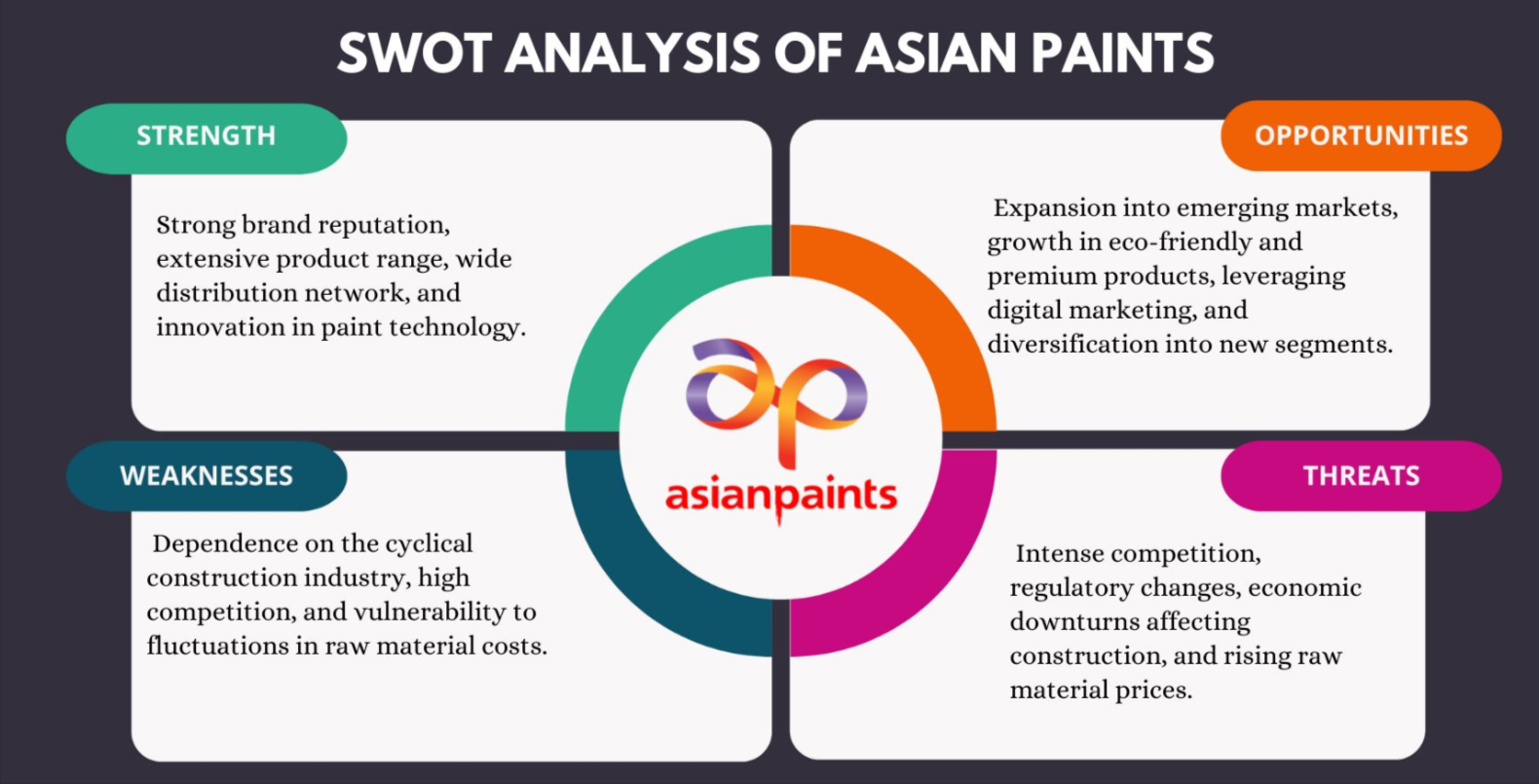
Asian Paints is India’s largest decorative paint maker, and Asia’s third-largest in the world. Established in 1942, the company has grown to an enormous revenue juggernaut of Rs36,183 crore for FY 2024, and net earnings of Rs 5,558 crore. However, the last few quarters have been characterized by increasing challenges. Q4 FY25’s net profit fell 45percent YoY to Rs692 crore. This was a significant drop that missed estimates, and a decline in revenue and a shrinking margin. The the Grasim’s Birla Opus which reduced the market’s share down from 59% 52% over the course of a year-long period, intensified. As the quarter’s Q1 FY26 results due on July 29th, market watchers are anxious to find out if growth in margins and urban demand occur. Let’s look at the strategic positioning for Asian Paints via SWOT.
Strengths
1. The dominant market share: Having more than 50% of decorative paints from India, Asian Paints enjoys unrivalled trust in its brand, distribution capabilities in addition to a strong retail position.
2. Consistent Profitability and Financial Growth The company has achieved between 8 and 12 percent CAGR over the course of five years. Q4 FY24 revenues of around Rs36k crore, and operating profit of 7,215 crore.
3. Worldwide Production & Distribution network covers 27 facilities in 15 countries, and serves over 60 countries and making it a significant global player.
4. Technology and Supply Chain: Revolutionary tech use–similar to supercomputers since the 1970s –and integrated ERP/SAP systems have facilitated the efficiency of supply chains and cost control .
5. Solid Brand Equity In the list of the top 20 brands in India, Asian Paints has high recall and trust, bolstered by a sustainable and creative branding.
The weaknesses
1. Dependence too heavily of Decorative Paints: With decorative segment accounting for 90 percent of revenues The company is heavily dependent on consumer demand for housing.
2. A decline in the Q4 of FY25 performance The Q4 FY25 performance was an increase of 4.3 percent decline in sales YoY and a 45percent drop in net income, caused by a weaker urban demand and the sale of the Indonesian unit.
3. Insufficient performance in Automotive and Industrial Coatings: Despite a presence, its market share in industrial coatings is still low (~15 percent) when compared with competitors such as Kansai Nerolac.
4. Vulnerability to Rapid Consumer Trends: Shifts in consumer preferences demand agile production–overproduction or inventory lag pose challenges.
Opportunities
1. Infrastructure and Real Property Growth: Growing urbanization, demand for housing, as well as government-sponsored initiatives (e.g., CLSS) encourage decorative paint use.
2. Expanding of Industrial and Auto Coatings: The growing automotive and manufacturing sectors provide the possibility of diversifying into higher-margin industrial coatings.
3. Geographic Expansion into Emerging Markets Utilizing its existing facilities situated in Africa as well as Southeast Asia, plus new manufacturing facilities, Asian Paints can scale exports.
4. Demand for Sustainable and Green Paints A rising demand from consumers and regulators for eco-friendly paints open the door for innovation in product design.
5. Digital and Design-Centric Services Home decor solutions that are launched as well as digital tools for visualization (Beautiful Homes) will increase the engagement of customers and add the value.
Threats
1. Aggressive New Entry: Birla Opus’ rapid share capture (6.8 percent) and aggressive discounts for dealers can affect margins and volumes.
2. Weak Rural & Urban Demand: Ongoing demand sluggishness–especially in urban areas–continues to dampen sales and margins .
3. The Inflation of Raw Materials: Changing prices for titanium dioxide and solvents and pigments could reduce margins, if not accompanied by timely price pass-through .
4. Environmental and Regulatory Constraints: Cleaner production guidelines and paint VOC rules could raise the cost of compliance significantly .
5. Competition Discount Pressure Continued discounting by rivals could lead to the possibility of a price war, which could affect profits and revenue.
Future Outlook
Recovery in Demand for Urban Services: If Q1 FY26 exhibits signs of urban revival higher margins and stabilized revenue are likely, particularly when a new product mix is a key factor in the recovery.
Margin Resilience via Scale & Leverage: Restored operating leverage and shrewd price passes can ensure profitability despite inflation of inputs.
Diversification into Related Segments: Pushing into industrial coatings green paints, green coatings and decor services may aid in reducing the need for decorative paints and increase mix.
Geographic and the growth of exports: Tapping into international demand and enhancing its manufacturing presence all over Asia and Africa can open new avenues.
Digital and Customer-Centric Acceleration: Strengthening digital services such as predictive color tools and home decor platforms could increase the loyalty of customers and boost use.
Adjustment of Competitive Strategies: Asian Paints must balance the strategy of pricing and differentiate in order to stop discount-driven encroachment from Birla Opus.
Asian Paints remains the category leading brand, but it is in the thorny demand and competitive environment. The resurgence of urban expenditure, cost resiliency and diversification to industrial paint, décor services as well as green coatings, will decide whether the company can maintain its leadership or suffer market share losses. The results of Q1 FY26 on the 29th of July will be an important measure of the company’s ability to gain momentum.