
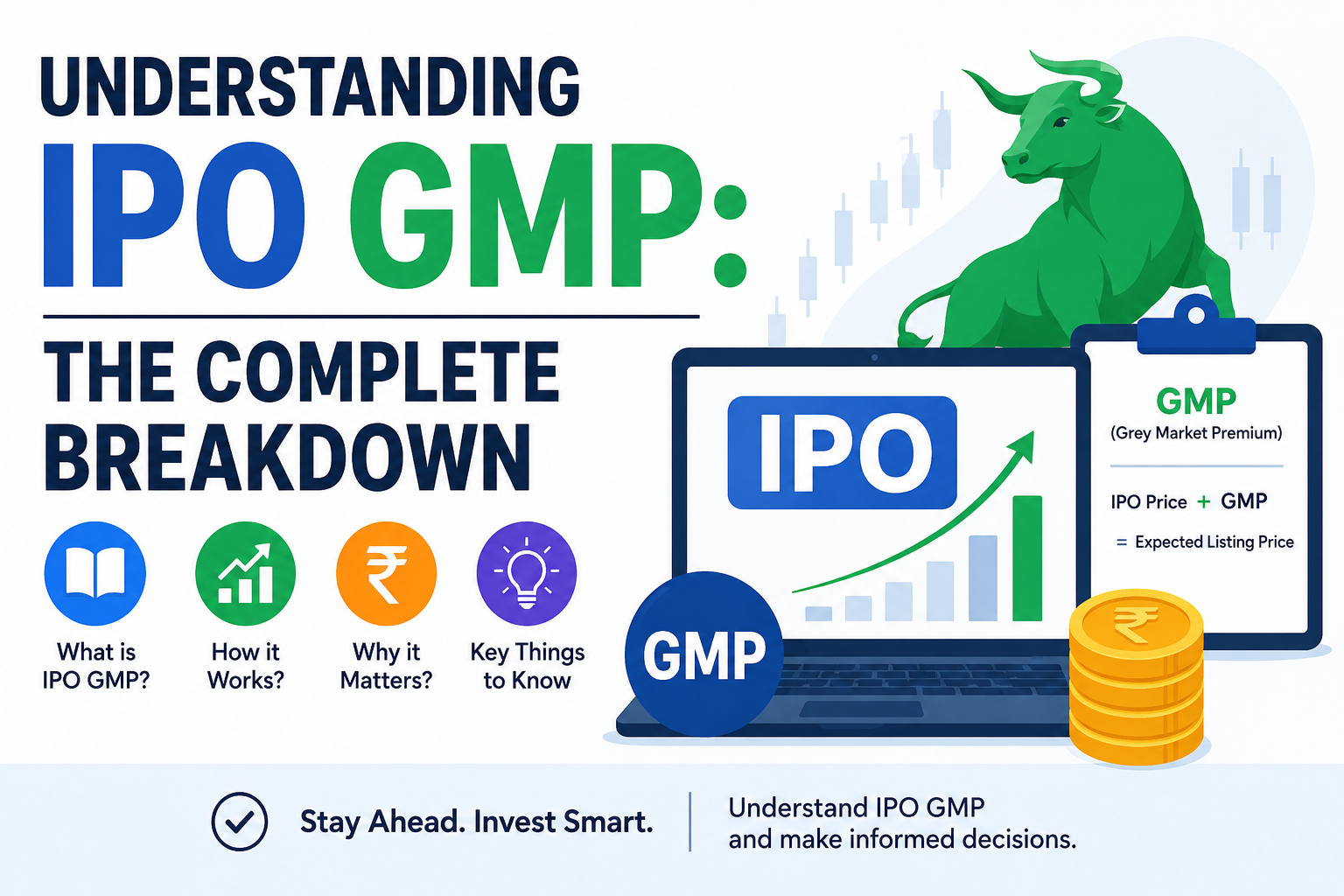
Whenever a highly anticipated company announces its intention to go public, the stock market community immediately buzzes with speculation. Long before the opening bell rings on the National Stock Exchange (NSE) or Bombay Stock Exchange (BSE), another market is already actively trading these shares. This is the grey market.
The grey market operates as an unofficial, parallel financial ecosystem. Because it exists outside the regulatory framework of authorities like the Securities and Exchange Board of India (SEBI), it relies entirely on trust, localized broker networks, and cash transactions. The most critical metric produced by this unregulated environment is the IPO GMP.
When demand for an upcoming IPO is incredibly high and supply is limited, buyers willingly offer a premium over the company’s official issue price. This premium reflects investor enthusiasm and market liquidity. Conversely, if institutional and retail interest is weak, shares might trade at a discount, resulting in a negative IPO GMP.
How Does the Unofficial Grey Market Work?
To fully grasp IPO GMP, you need to understand the mechanics of the grey market. Here is the step-by-step process of how informal trading occurs:
- The Announcement: A company sets a price band for its upcoming IPO.
- Early Bidding: Before the allotment is finalized, buyers who fear they won’t get shares through the standard lottery system approach informal grey market dealers.
- Setting the Premium: These buyers offer an extra amount (the IPO GMP) to individuals who have applied for the IPO, convincing them to sell their potential allotment.
- The Agreement: The seller agrees to transfer the shares to the buyer’s demat account on listing day at a pre-agreed price, or settle the cash difference.
How to Calculate Grey Market Premium
Calculating the expected listing price using the grey market premium is incredibly straightforward. You only need two pieces of data: the upper band of the official issue price and the current IPO GMP on IPO Dashboard.
The Formula: Expected Listing Price = IPO Issue Price + IPO GMP
Real-World Example
Let’s say a major technology company announces its IPO with an issue price of ₹500 per share. The market is incredibly bullish on the tech sector, and the current IPO GMP on a trusted tracking site is ₹150.
- Expected Listing Price = ₹500 + ₹150 = ₹650.
- Expected Listing Gain = 30%.
If the broader market conditions turn sour, the GMP might drop to a negative ₹50. In that scenario, the grey market predicts a listing price of ₹450, representing a potential 10% loss on listing day.
Why IPOIndex.in is the Best Platform for IPO GMP Tracking
Because the grey market is entirely informal, finding accurate, centralized, and reliable premium data can be incredibly difficult. Prices fluctuate hourly based on rumors, QIB (Qualified Institutional Buyer) subscription numbers, and global market trends. This is where Platform becomes an indispensable tool for the modern investor.
Instead of relying on fragmented WhatsApp groups or localized brokers, IPOIndex.in aggregates live grey market sentiments into one easily accessible dashboard.
Key Features of IPOIndex.in
- Live GMP Updates: The platform tracks and updates premium fluctuations daily, giving you the most accurate pre-listing sentiment available.
- Subscription Tracking: Juxtaposes the GMP with live subscription data across Retail, NII, and QIB categories, allowing for deeper fundamental analysis.
- Historical Accuracy: Investors can review past IPOs on the site to see how closely the GMP tracked by IPOIndex.in matched the actual listing gains.
- Allotment Status: A seamless interface to check whether your PAN has been successfully allotted shares once the registrar finalizes the process.
By bookmarking this platform, you equip yourself with institutional-grade data, turning speculative guessing into informed, data-backed investing.
Kostak Rates and Subject to Sauda (SS)
While IPO GMP is the most popular metric, the grey market utilizes other unique trading mechanisms that savvy investors should understand.
1. Kostak Rate
The Kostak rate is the fixed amount a buyer pays to a seller for their entire IPO application, regardless of whether the seller actually receives an allotment.
- If you apply for a highly oversubscribed IPO, your chances of allotment are slim.
- A buyer might offer you ₹2,000 as a Kostak rate for your application.
- You keep the ₹2,000 profit whether you get the shares or not. If you do get the allotment, you must surrender the shares to the buyer. This is a brilliant way to lock in risk-free profits.
2. Subject to Sauda (SS)
“Subject to Sauda” is similar to the Kostak rate, but with one critical difference: the deal is only valid if the seller actually receives the share allotment. If the seller’s application is rejected in the lottery, the deal is canceled, and no money exchanges hands. This protects the buyer from paying premiums on empty applications.
Factors That Influence Grey Market Fluctuations
IPO GMP is highly volatile. It is not a static number and can change drastically from the date the IPO opens to the actual listing day. Several macroeconomic and microeconomic factors drive these shifts:
- QIB Subscription Numbers: Institutional money moves markets. If Qualified Institutional Buyers oversubscribe to an IPO by 50x or 100x, the retail panic sets in, and the IPO GMP skyrockets.
- Broader Market Sentiment: Even a fundamentally strong company will see its grey market premium shrink if the Nifty or Sensex experiences a sudden crash due to global economic fears.
- Company Valuations: If analysts believe the IPO’s Price-to-Earnings (P/E) ratio is too expensive compared to listed industry peers, the GMP will struggle to gain traction.
- Brand Perception: Household names and recognizable consumer brands typically command higher premiums purely based on retail investor enthusiasm and brand loyalty.
Is IPO GMP a Guaranteed Predictor of Listing Gains?
The most important lesson for any investor is that the grey market is a sentiment tracker, not a crystal ball. Relying purely on IPO GMP without doing your own due diligence is a dangerous game.
While a high premium often correlates with a strong market debut, it is not guaranteed. There have been numerous historical instances where an IPO boasted a massive GMP during the subscription phase, only to list flat or at a discount because broader market sentiment soured on the actual listing day.
Use IPO GMP as just one tool in your arsenal. Combine the grey market data found on This platform with a thorough reading of the company’s Red Herring Prospectus (RHP), a deep dive into their financials, and an understanding of the current macroeconomic climate.
Frequently Asked Questions (People Also Ask)
Is trading in the IPO grey market legal in India? Trading in the grey market is not officially recognized or regulated by SEBI. While it is not explicitly a criminal offense to agree on a price before listing, the trades are entirely unofficial. If a buyer or seller defaults on a grey market deal, there is no legal recourse or regulatory body to protect the defrauded party.
Can IPO GMP be negative? Yes, an IPO GMP can absolutely be negative. A negative premium indicates that the unofficial market expects the stock to list below its issue price. This usually happens when the IPO is considered overpriced, or the company has weak financials.
How often does the IPO GMP change? The premium can change daily and sometimes even hourly. It fluctuates based on live subscription data, news regarding the company, and overall stock market volatility. This is why checking a reliable tracker like Website daily is highly recommended.
Should I invest in an IPO solely based on a high GMP? No. While a high IPO GMP indicates strong demand, it should never be the sole basis for your investment. Always analyze the company’s long-term growth prospects, debt levels, and profitability before tying up your capital.
Conclusion: Mastering Pre-Listing Sentiment
Understanding IPO GMP provides a fascinating look into the psychology of the stock market. It quantifies hope, fear, demand, and anticipation long before a company officially becomes public. By keeping an eye on the grey market premium, you can better navigate the chaotic days leading up to a listing, manage your expectations, and formulate smarter exit strategies.
To stay ahead of the curve, make it a habit to check the live sentiment data. Head over to today to track the latest IPO GMPs, analyze live subscription statuses, and equip yourself with the insights needed to conquer the primary market!