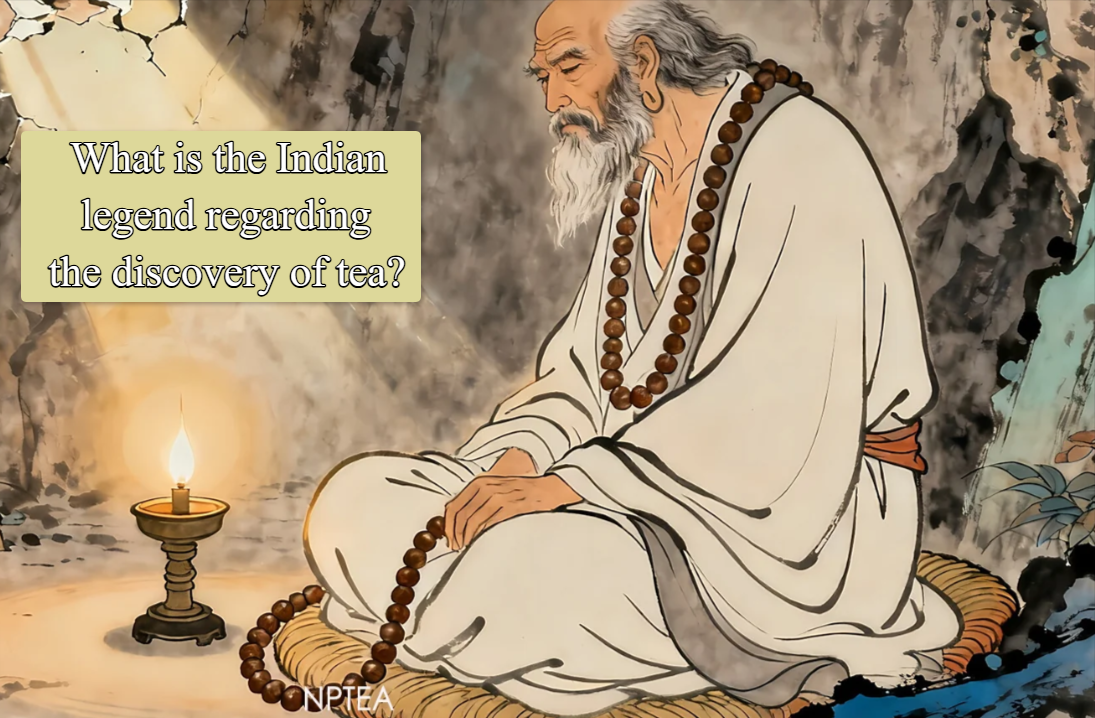
Tea, the world’s second most loved beverage, second only to water, has an array of legends and stories that span centuries and continents. Some of the more fascinating stories can be found in the Indian legend about the discovery of tea that weaves faith, perseverance and serendipity in a story that has been awed by generations of. This tale, usually is attributed to Bodhidharma, the Buddhist monk Bodhidharma and is different from the more popularly documented Chinese sources, yet gives a distinct cultural flavour to the global tea story. In this in-depth investigation, we’ll explore the story’s specifics and it’s historical significance, the comparisons against other stories, as well as its importance in the present. You may be a student studying for an assignment in class or a tea lover who is curious about its origins in the past, this article will reveal the underlying stories behind this fascinating folklore.
Introduction Capturing Indian legend regarding the discovery of tea
Ever wondered about how one single leaf was transformed into a symbol of perseverance and awakening? In the simplest sense, this legend is about Bodhidharma an enigmatic character from the south of India who traveled to China during either the fifth or sixth century of CE. He was there to propagate Zen Buddhism. His fervent devotion during meditation is believed to have created the tea plant and provided an alcoholic beverage that eases tiredness and helps sharpen the mind. The scientific evidence supports tea’s roots from China’s Yunnan province millennia before this story is an allegory of the connection that connects Indian religion along with East Asian tea culture. Beyond the mere folklore, it illustrates how myths change in order to describe natural phenomenon similar to caffeine’s effects on alertness.
The Indian Legend in Detail: Bodhidharma’s Epic Journey
The legend begins through Bodhidharma who was the prince born within the Pallava dynasty in southern India in the fifth century of CE. Refusing to live a royal life and becoming an unremitting monk, devoted towards Chan (Zen) Buddhism. His journeys took him through to the Himalayas towards China’s Shaolin Temple in order to instruct meditation and enlightenment. The idea of sitting in front of the wall of a cave for nine uninterrupted years, with no sleep, Bodhidharma encountered a human fragility of sleepiness. In a vivid retelling in the fifth year of his life the sage fell asleep. When he awoke, angry by his insanity and in rage, he cut off his eyelids and dumped them onto the ground. Amazingly, wherever the eyelids landed on the ground, the first tea bushes grew. The leaves, with the shape of eyelids, with sharp edges that resembled eyelashes, were made into a energizing infusion that kept him and later his followers–alert with rigorous religious rituals.
The tale is told in many variations, adding the nuances and flexibility. In certain Indian as well as Chinese version, Bodhidharma simply chews on nearby wild leaves in order to fight fatigue, gaining their stimulating properties, without the dramatic self-mutilation. Japanese folklore transforms to create the “Daruma” symbol, in which eyes-free dolls symbolize unwavering determination and further infuse tea into the cultural symbolism. These adaptations show the fluidity of oral storytelling, highlighting tea’s caffeine content, which is confirmed by modern science to block the adenosine receptors that promote sleep–as an aid to enlightenment seekers. Early mentions of the tea are within Tang Dynasty (618-907 CE) Buddhist texts, but historians see it as embellished folklore instead of a true facts.
A Historical, Scientific and Cultural Context Myths against. Reality
Although the Bodhidharma legend is captivating, scientific and historical evidence suggests the opposite story. It is believed that tea (Camellia sinensis) probably originated from the southwestern region of China’s Yunnan region between 2737 and 2737 BCE which is the region with the most genetic diversity observed there as proven by research by institutions such as that of the Food and Agriculture Organization (FAO). Archaeological finds, such as ancient tea residues dating back to The Han Dynasty (206 BCE-220 CE) prove this. In India tea’s commercialization began much later. The year 1823 was when Scottish aventurier Robert Bruce discovered in the wilderness Assam tea trees (var. assamica) that were used by tribes in the area, which led to British cultivation starting in 1839. Assamica was a plant used by local tribes. East India Company, seeking to break China’s monopoly during the Opium Wars, employed botanist Robert Fortune to smuggle seeds and other techniques between 1848 and 1851.
Controversies emerged in the 19th century, when Western experts debated the origins of tea from Assam’s wild tree however, modern genetics support China’s supremacy, pointing to Assam varieties as offshoots of the evolutionary. The Bodhidharma mythology may have been popularized in British colonial campaigns and was cited in 1887’s writings, attempting in order to “Indianize” tea to promote marketing. In the present, India produces over 1.2 billion kilograms per year and Assam making up half of the total, mixing the legacy of colonialism with indigenous mythology.
To make clear the distinctions Here’s a table that summarizes the key elements:
| Aspect | Indian Legend (Bodhidharma) | Scientific/Historical Evidence |
|---|---|---|
| Time Period | 5th-6th Century CE | 2737 BCE in China |
| Discovery Mechanism | Eyelids growing into plants | Wild harvesting is taking place in Yunnan |
| Key Figure | Buddhist monks from India | King Shen Nong (mythical) |
| Cultural Role | A symbol of spiritual alertness | Basis for medical and daily use |
| Modern Validation | Allegorical; no direct evidence | Studies in genetics and archaeology |
Comparisons with other Legends Comparisons to Other Legends: A Global Tapestry
The Indian story is a part of other myths about origins, adding to the tea’s tale. The most famous is China’s Emperor Shen Nog legend. In 2737 BCE as the water was boiling under trees, leaves floated into the pond, forming an energizing drink that cleansed the man after tasting poisons. In texts such as that of Shennong Ben Cao Jing and Lu Yu’s 8th century Cha Jing, it focuses on accidental invention as well as the wisdom of herbs. Japanese versions attribute monk Eisai with importing tea during the 12th century. The tea evolved into the ceremonial cha-no-yu. Korean folklore says it was a result of a the 4th century monk Sundo plant seeds near temples.
These stories enabled cultural exchange through and the Silk Road, with Bodhidharma’s version including a sacrificial aspect that was not present in shen nong’s serendipity. A table of comparisons shows the variety:
| Legend Origin | Central Figure | Discovery Method | The Core Theme |
|---|---|---|---|
| Indian | Bodhidharma | The eyes of tea plantas are glued to the lids | Inspiring and selfless sacrifice |
| Chinese | Shen Nong | Leaves immersed in boiling water | Medical experimentation |
| Japanese | Eisai | Imported from China | Harmony and Ritual |
| Korean | Sundo | The seeds are planted near the temple | Peace and illumination |
This global view illustrates how tea mythologies change to local cultural values that range from India’s spirituality to the practical use of Chinese herbs.
Contemporary and Cultural Significance From Folklore to Modern Life
It is believed that the Bodhidharma legend’s influence stretches to far beyond the text of ancient times. In India the legend is mentioned within the NCERT Class 10 English textbook chapter “Tea from Assam” in First Flight in which characters talk about as well Indian and Chinese mythologies on the journey by train to Assam. In terms of culture, it encourages tourists to Assam’s tea estates and guides tell the story amid rolling hills, employing millions of people and exporting strong black teas to the world.
In more general East Asian contexts, the legends of the region was the basis for Buddhist practices in general, with tea serving as a means of facilitating long meditations, and later becoming Japanese ceremony for tea. Modern science is in line with the underlying themes of tea’s polyphenols and caffeine can provide health benefits such as improved focus and antioxidants. These are backed by research from institutions like The Harvard T.H. Chan School of Public Health.
Conclusion: The Persistent Charm of Tea’s Mythical Origins
The Indian tale of the Bodhidharma’s heroic act, reminds us of the fact that amazing stories often arise from the earliest seeds of human endeavour. Although it is rooted in mythology this story helps us gain a better understanding of the journey of tea from wild plants into a regular ritual that is enjoyed by millions. While we enjoy the next cup, we should be aware of the threads of culture which connect us.
Are you eager to try the legend? Check out our collection that is traditional Assam teas and taste their distinctive flavor today.
